
Almost every company running large AI models pays a tax, and the tax is named Nvidia. A small team in Reno thinks there is a cheaper way, at least for the part that matters most.
That part is inference. Training a model is the famous, expensive, headline part. But once a model is trained, every single answer it gives, every chatbot reply and every summarized document, is a separate act of inference. As AI moves from demos into daily use, inference is where the real and recurring cost lives, and it is mostly paid in electricity and in Nvidia GPUs. Positron, founded in 2023 and headquartered in Reno, is built around one contrarian claim about that cost.
The bet: it is the memory, not the math
The conventional race is about raw compute, more math per second. Positron argues that for running today's large language models, the real bottleneck is memory bandwidth, how fast the chip can move a model's enormous weights in and out of memory. On that view, a general-purpose GPU spends much of its time waiting, using only a fraction of its memory bandwidth. Positron designed its hardware around memory instead, and claims its systems use the vast majority of available memory bandwidth where a typical GPU setup uses a small share.
Its first product, a server called Atlas, is already shipping and built to run large models efficiently in a standard, air-cooled rack. The company makes bold comparisons against Nvidia's chips on performance per dollar and performance per watt, and a more ambitious custom chip is already on its roadmap. Those benchmark numbers are Positron's own claims, made in the heat of a fundraising and marketing push, and deserve the usual skepticism until independent testing confirms them. What is not in dispute is that serious buyers are paying attention.
"Energy availability has emerged as a key bottleneck for AI deployment."
From Atlas to Asimov
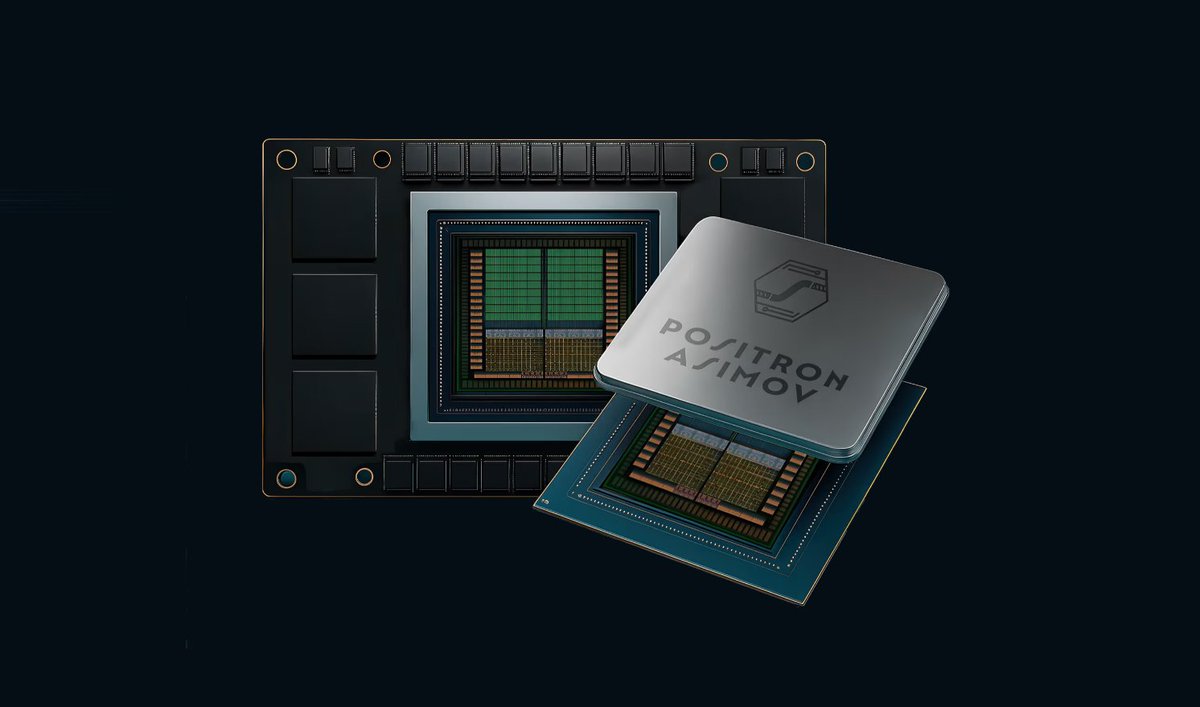
Atlas is the product that exists today, an air-cooled server the company says runs very large models in a single rack while drawing a fraction of the power of a comparable Nvidia system. It is shipping and deployed, not a slide. The harder, bigger swing is the next chip, a fully custom design called Asimov, slated to tape out in late 2026 and reach production in 2027 on TSMC's most advanced node. Positron claims Asimov will carry far more memory per chip than the Nvidia parts it aims to beat, and deliver several times the tokens per watt of Nvidia's next generation. If even a portion of that survives independent testing, it changes what it costs to serve AI at scale, which is the whole point.
The people and the money
Positron was started by Thomas Sohmers, a former Thiel Fellow who has spent his career on processor architecture, and Edward Kmett, a well-known computer scientist who came from the AI-chip company Groq, along with Barrett Woodside. In early 2025 the company brought in Mitesh Agrawal as chief executive. Agrawal had been chief operating officer at Lambda, where he helped scale an AI-cloud business from a tiny revenue base into the hundreds of millions, which is exactly the commercial muscle a hardware startup needs.
The money arrived fast. A $23.5 million seed round in February 2025 was followed by an oversubscribed $51.6 million Series A that July, and then, in February 2026, a $230 million Series B at a valuation above a billion dollars. That made Positron a unicorn roughly three years after it was founded, with more than $300 million raised in total. The Series B was co-led by trading and investment firms including Jump Trading, which had started out as a customer before it became an investor, with strategic backing that included Arm and the Qatar Investment Authority.
The most important validation was not a check. It was a deployment. In 2026 Positron sold its chips into Oracle's cloud, placing systems worth tens of millions of dollars into a major data-center operator's infrastructure. Positron's chief executive has framed it as a milestone that, outside of Nvidia and AMD, no other AI-silicon startup has reached: actually getting deployed inside a hyperscale cloud.
Outside Nvidia and AMD, the first AI-silicon startup to get actually deployed inside a hyperscale cloud.
Customers, and a "made in America" asterisk
Beyond Oracle, Positron has assembled the kind of partner list that signals it is being taken seriously. Jump Trading, the secretive trading firm, was a customer before it became a co-lead investor. Arm named Positron among the launch partners for its new data-center processor effort. The networking company Tailscale helps power a "try before you buy" service that lets prospective buyers test Positron servers, which currently run in a Washington State data center.
There is an honest asterisk on the American-made branding. Positron's first-generation hardware is FPGA-based and assembled in the United States, but the advanced Asimov chip will be fabricated by TSMC in Taiwan, because leading-edge capacity in Arizona is spoken for. That is the constraint nearly every U.S. chip designer faces right now. The design, the architecture, and the company are American, and Nevada's. The most cutting-edge fabrication, for the moment, is not.
In June 2026 Positron opened its first office outside the United States, at the Dubai International Financial Centre, a sign it intends to sell globally and not only supply American clouds.
Why it matters that this is a Reno company
Positron is small, on the order of a couple dozen people, and it is still early, still mostly promise rather than proven dominance. Its chips are designed in Reno, even though the most advanced fabrication happens at the big foundries elsewhere, which is true of nearly every American chip company. But the headquarters, the architecture, and the bet are Nevada's. The regional development group EDAWN has held Positron up as evidence that Northern Nevada is becoming a real node in the AI economy, alongside the data centers and battery plants already here.
That is the optimistic thread worth pulling. Reno spent a decade attracting the warehouses and the gigafactories. A company like Positron is something different: not a campus relocated here for cheap land and no income tax, but high-end semiconductor design started here, by people who chose to build it in Nevada. Whether or not Positron ends up beating Nvidia, that is the kind of seed a tech economy grows from. It also needs the same things every growing employer needs, including housing its engineers can afford, which is where the rest of what we write about comes back in.
Reporting drawn from Positron's funding announcements, EE Times, Tom's Hardware, VentureBeat, TechCrunch, the Northern Nevada Business Weekly, and EDAWN, among others. Performance comparisons against Nvidia hardware are the company's own claims pending independent benchmarks, and exact chip specifications vary across sources. The pull-quote is attributed to chief executive Mitesh Agrawal in coverage of the February 2026 Series B. Images courtesy of Positron AI. We will update as independent testing and further details emerge.